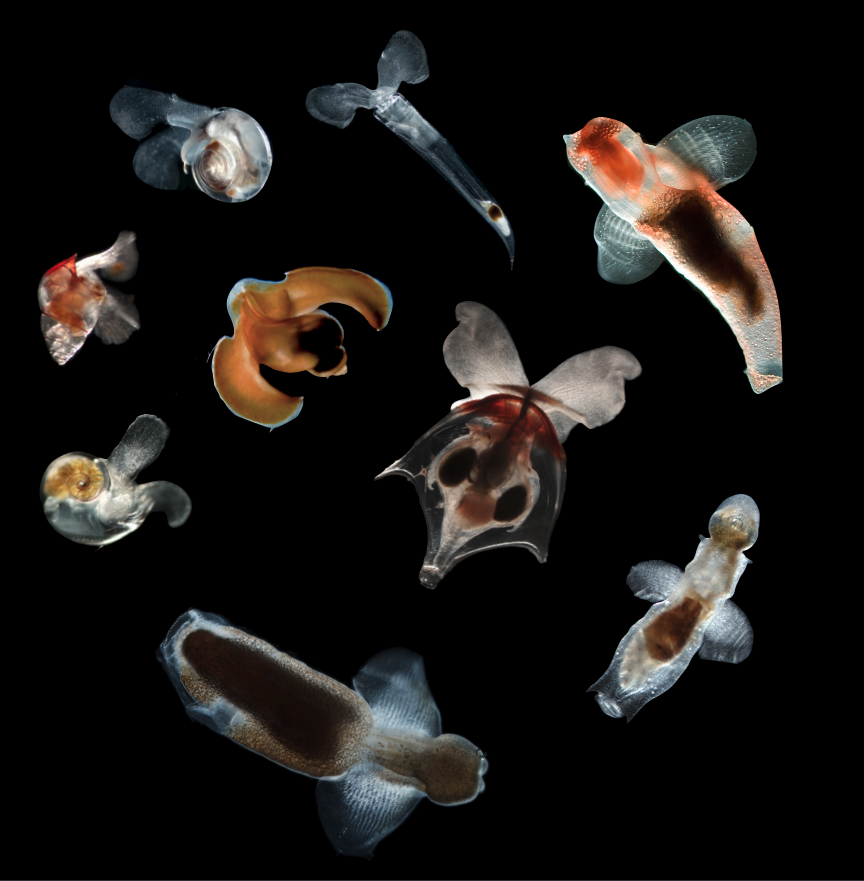

Pteropods are a group of planktonic gastropods that are widely regarded as biological indicators for assessing the impacts of ocean acidification. Their thin aragonitic shells are highly sensitive to acute changes in ocean chemistry. However, to gain insight into their potential to adapt to current climate change, we need to accurately reconstruct their evolutionary history and assess their responses to past changes in Earth’s carbon cycle. Katja Peijnenburg et al resolve the phylogeny and timing of pteropod evolution with a phylogenomic dataset and fossil evidence. In agreement with traditional taxonomy, they recovered the first molecular support for a division between sea butterflies (Thecosomata: mucus-web feeders) and sea angels (Gymnosomata: active predators). Molecular dating demonstrates that these two lineages diverged in the early Cretaceous, and that all main pteropod clades, including shelled, partially-shelled and unshelled groups, diverged in the mid to late Cretaceous. Hence, these clades originated prior to and subsequently survived major global change events, including the Paleocene Eocene Thermal Maximum (PETM), which is the closest analogue to modern-day ocean acidification and warming. Their findings indicate that planktonic aragonitic calcifiers have been resilient to extreme perturbations in the Earth’s carbon cycle over evolutionary timescales.
Time: 16:00 | Place: https://meet.google.com/fph-ezrx-kwk | Drinks afterwards! (on your own behalf)